TLDR: TV Stand Buying Guide South Africa
- Width: Stand should be 10–15cm wider than your TV on each side. A 65-inch TV is ~145cm wide - use a 160cm+ stand.
- Height: 40–55cm stand height puts your screen centre at ~100–115cm from the floor - ideal for couch viewing.
- Freestanding vs wall-mount: Freestanding suits renters and families; wall-mounted suits homeowners who want a minimal look.
- Best material for SA: MDF or engineered wood - handles temperature variation, easy to clean, wide range of finishes.
- Current style trend: Light oak and warm wood tones dominate. White remains safe and timeless.
- Best SA price range: R995–R3,950 covers the full range from compact bedroom stand to premium 180cm living room unit.
Table of Contents
- What size TV stand do I need for my TV?
- How high should a TV stand be?
- TV stand vs TV unit vs TV panel: what is the difference?
- Freestanding vs wall-mounted: which is better?
- TV stand materials: which one should you choose?
- TV stand styles for South African homes
- How do I stop my TV stand looking cluttered?
- Click Furniture's top TV stand picks
- Frequently asked questions
What Size TV Stand Do I Need for My TV? {#size}
The size printed on your TV box - 55 inch, 65 inch, 75 inch - is a diagonal measurement of the screen only. It tells you nothing about how wide the actual TV is from edge to edge, and that is the number that determines which stand fits.
How to measure your TV for a stand
Turn your TV around and measure the widest point from left edge to right edge, including the bezel. Then add 20–30cm to get your ideal stand width. As a rule: choose a stand that is at least 10–15cm wider than your TV on each side. A stand that is narrower than your TV creates a top-heavy look and a tipping risk.
Use this quick-reference table:
| TV Screen Size | Approx. TV Width | Minimum Stand Width | Recommended Stand Width |
|---|---|---|---|
| 43 inch | ~96cm | 96cm | 110–120cm |
| 50 inch | ~112cm | 112cm | 120–130cm |
| 55 inch | ~123cm | 123cm | 130–145cm |
| 65 inch | ~145cm | 145cm | 155–170cm |
| 75 inch | ~167cm | 167cm | 180–200cm |
How much wall space do you have?
Before picking a stand, measure the wall where it will sit. Leave at least 30cm of clear space on either side of the stand so the room does not feel cramped. A 150cm wall suits a 120cm stand. A wall of 180cm or more can take a 160–185cm panel, which anchors the space far better and gives you more storage.
How High Should a TV Stand Be? {#height}
A stand that is too low forces you to look down and strains your neck over a long session. One that is too high makes you look up, which is just as bad. The sweet spot is simple: the centre of your TV screen should sit at seated eye level.
For most South African couches - seat height roughly 45cm, seated eye level roughly 105–110cm from the floor - you want the TV screen centre at 100–115cm from the floor. Most freestanding TV stands sit 40–55cm high. When you add a 55-inch TV (about 70cm tall) on top, the screen centre lands at around 105–120cm, which is exactly right.
Research confirms this range: when the screen is too high or low, the body quietly compensates by tilting the head and craning the neck - do that for a full series and your shoulders pay the price.
What if your stand is too low?
If you have a very low-profile stand (under 40cm) and a large TV, the screen centre drops below comfortable viewing height. The fix: choose a stand with raised legs - hairpin or tapered wooden legs add 10–15cm of height without adding visual bulk. Click Furniture's Bolton range uses this approach: an engineered wood cabinet on slim metal legs that keeps the footprint light while bringing the screen to the right height.
TV stand height for bedrooms
Bedroom viewing usually happens from a higher position - lying flat or propped on pillows - so you can go higher. Bedroom TV stands can sit 60–70cm high without causing discomfort. The TV panel range, which mounts the TV on a vertical backing board at an adjustable height, works especially well in bedroom setups.
TV Stand vs TV Unit vs TV Panel: What Is the Difference? {#types}
These terms get used interchangeably in South Africa, but they do describe different products.
| Term | What It Is | Best For |
|---|---|---|
| TV stand | A compact, freestanding piece - often 80–130cm wide with shelving or a small cabinet below the TV. | Small to medium rooms, renters, budget-conscious buyers. |
| TV panel | A wall-panel system that brackets the TV onto a vertical backing board. Often includes shelving above and below. | Renters who want a wall-mount look without drilling; small rooms. |
| TV unit / TV console | A long, low-profile piece - typically 140–200cm wide - with multiple storage sections. | Medium to large living rooms, open-plan spaces. |
| Entertainment centre | A large floor-to-ceiling shelving system surrounding the TV. | Large lounges, dedicated home theatre setups. |
For most South African homes - apartments, townhouses and smaller suburban living rooms - a TV stand or TV unit in the 120–185cm range is the practical sweet spot. Enough storage for a decoder, soundbar and gaming console, the right scale, without dominating the room.
Freestanding vs Wall-Mounted: Which Is Better for South African Homes? {#mounting}
This is the most common question South African furniture shoppers ask, and the answer depends almost entirely on whether you own or rent your home. Both confirm: each option solves a different problem.
Freestanding TV stands
Pros:
- No drilling required - ideal for renters or leased properties
- Easy to reposition when you rearrange the room
- Built-in storage (shelves, cabinets) for decoders, soundbars and gaming consoles
- No wall reinforcement needed
- More affordable overall
Cons:
- Takes up floor space
- Cables are more visible without a cable management channel
- Slightly less "floating" aesthetic
Best for: Renters, families with young children (freestanding stands can be wall-anchored with a furniture strap for tip-over safety), and anyone who wants practical built-in storage.
Wall-mounted TV units
Pros:
- Saves floor space - ideal for small rooms
- Clean, modern floating look with cables hidden behind the wall
- Creates the illusion of a larger room
Cons:
- Requires drilling - not ideal for renters
- The wall must support the weight (brick and solid plaster are fine; drywall needs special anchors)
- Installation adds cost and effort
- Hard to reposition later
Best for: Homeowners, open-plan living rooms, and buyers who want a minimal, contemporary aesthetic.
The practical middle ground for most South African homes: A freestanding TV unit in the 150–185cm range gives you the visual impact of a wall installation without the drilling, the installation cost, or the permanent commitment. All Click Furniture TV stands deliver free nationwide within 3–7 business days, so you can try it in your space without contractor fees.
TV Stand Materials: Which One Should You Choose? {#materials}
The material determines how long your stand lasts, how it looks over time, and how easy it is to maintain. Here is how the main options compare for South African conditions.
MDF and engineered wood (most common)
MDF (Medium Density Fibreboard) and engineered wood are the most widely used materials in South African TV stands. Compressed wood fibres are bound under heat and pressure, then finished with a laminate, UV paint or foil in virtually any colour.
- Durability: Good - resists warping in moderate humidity, holds assembly screws well
- Maintenance: Wipe clean with a damp cloth; avoid prolonged water exposure
- Finish options: White, oak, walnut, graphite, pine, marble-effect
- Price range: R995–R3,950 for most SA stands
- Best for: Most homes - the best combination of price, aesthetics and durability
Research confirms MDF's position as the preferred choice for value-conscious buyers who still want a polished look. It handles South Africa's temperature swings - dry Highveld winters, humid coastal summers - far better than solid wood, which is prone to expansion and cracking.
Solid wood
Solid pine, oak or teak TV stands offer genuine warmth and can last decades.
- Durability: Excellent with proper care
- Maintenance: Occasional oiling; more sensitive to humidity changes than MDF
- Price range: R4,000–R20,000+
- Best for: Premium living rooms, buyers making a long-term investment
Glass and metal
Glass-top or glass-shelf stands suit ultra-modern, minimalist interiors. Metal frames add an industrial edge.
- Durability: Good (tempered glass is robust), but requires careful handling
- Maintenance: Fingerprint-prone; needs regular glass cleaner
- Price range: R1,500–R5,000
- Best for: Contemporary apartments; not recommended in homes with young children
The verdict for South African homes
For the majority of South African buyers, MDF or engineered wood in an oak, white or graphite finish is the right call. It handles the local climate well, ships flat-pack safely, and suits both modern and transitional interior styles. The UV-painted boards used across the Click Furniture range resist friction, moisture and everyday cleaning without fading.
TV Stand Styles for South African Homes {#styles}
South African interior trends lean towards warm, natural materials and clean lines. The cold grey minimalism of the mid-2010s is out, replaced by warmth, texture and pieces that feel considered rather than default.
1. Light oak and warm wood tones
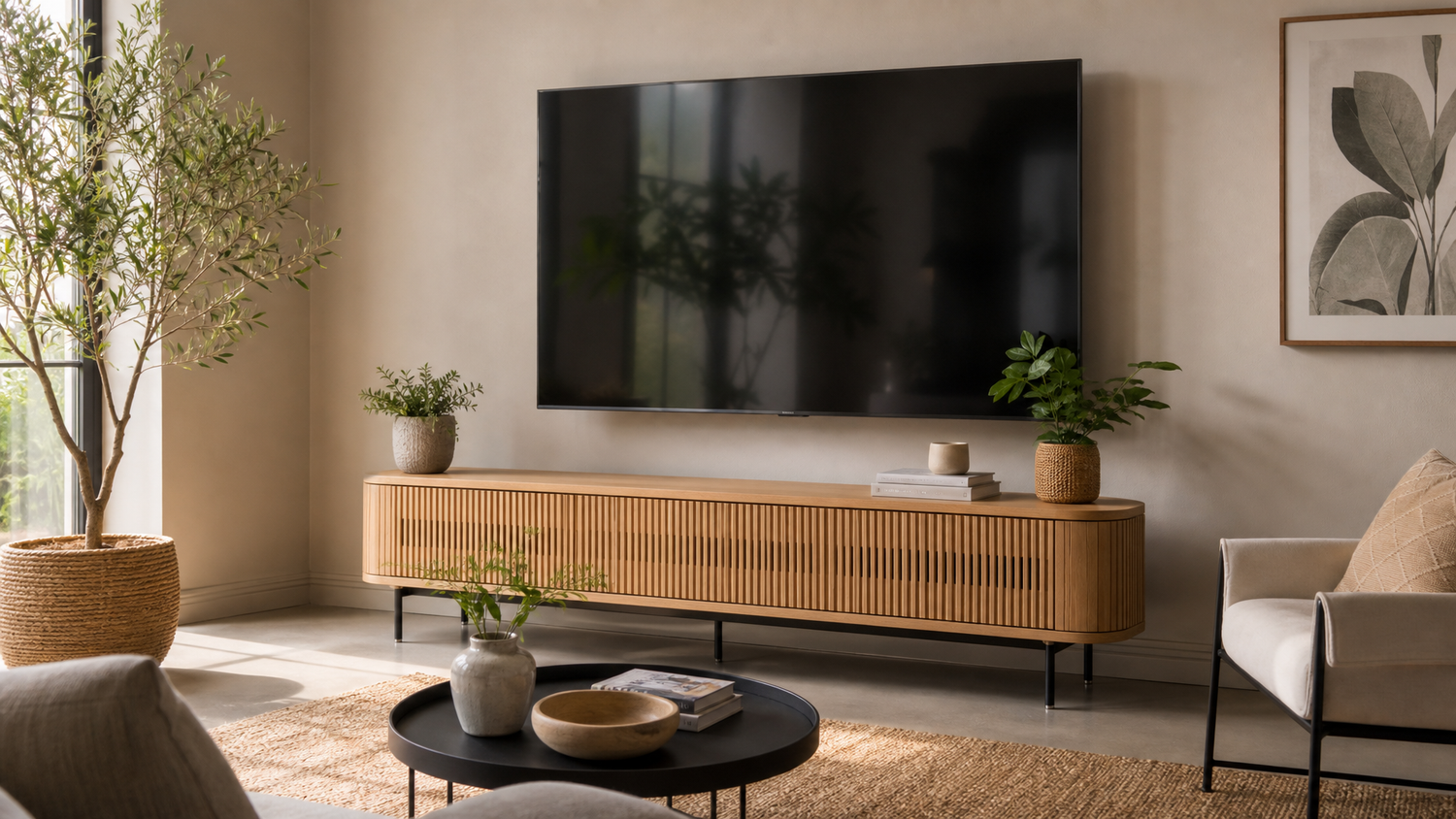
Honey-toned oak finishes are the single most popular TV stand style in South Africa right now. They pair naturally with white walls, grey couches and the indoor plant styling that dominates local interior accounts. Oak-effect finishes on engineered wood give you the look at a fraction of the cost of solid timber.
Pick: Bolton TV Stand Light Oak 120cm - R1,250 | Metal legs, slatted cabinet doors, supports up to 42" | In stock
Pick: Bolton TV Stand Light Oak 160cm - R2,250 | Same design, scaled for 65" TVs, ideal for medium to large living rooms | In stock
2. White and Scandinavian designs
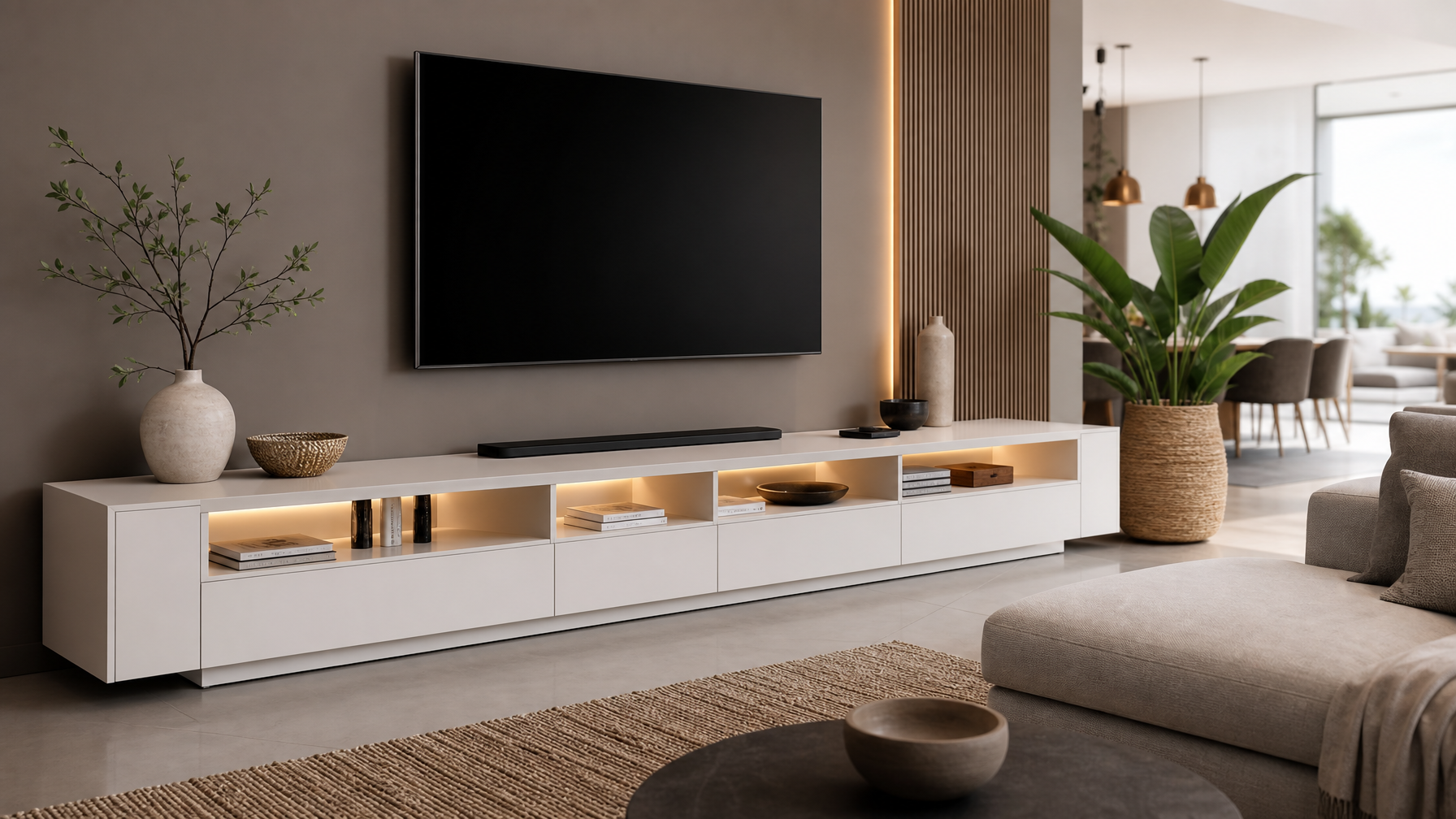
White TV stands work in almost any South African living room - they make small spaces feel bigger, suit both dark and light flooring, and age well as trends change. The Scandinavian revival adds tapered wooden legs and warm wood accents to soften the all-white look.
Pick: Helsinki TV Stand White - R1,750 | 185cm wide, sliding door, cable management hole, supports up to 65" | In stock
Pick: Liverpool White TV Stand - R2,950 | 180cm, mid-century Scandi design, drawer and two cabinet doors, 65" capacity | In stock
3. Bold dark tones - graphite, black, dark oak
Dark TV stands create a strong focal point in lighter rooms and work well against white or grey walls with brass or gold accent decor.
Pick: Lumina TV Stand Oak Graphite - R3,950 | 180cm, built-in LED lighting, inverted-edge top, supports 75" TVs | In stock
4. Marble-effect accents
The marble-and-metal trend has landed firmly in the mid-price TV stand category. Faux marble doors on an engineered wood frame give you the look without the weight or fragility of real stone.
Pick: Petra TV Stand White-Marble 160cm - R2,250 | White frame, faux marble doors, 65" capacity, metal legs | In stock
How Do I Stop My TV Stand Looking Cluttered? {#clutter}
The TV wall is the most looked-at part of any living room, which makes it the most punishing when it looks messy. A few cables, a decoder, a gaming console and a WiFi router on an open shelf create chaos fast. Here is what actually works.
1. Route cables through a back channel. Most quality stands have a cable management opening in the back panel. Thread all power and HDMI cables through it so they exit at the back, out of sight.
2. Use velcro straps to bundle cables. Even if you cannot fully hide them, bundling three cables together makes them look like one. Velcro ties (available at any hardware store for about R20) are better than zip ties because you can reopen them when you upgrade equipment.
3. Limit open-shelf items to three or fewer. Group objects in odd numbers and keep one shelf completely clear. A decoder, a candle and a small plant is a finished shelf. A decoder, a remote, three game cases, a router and a magazine stack is clutter.
4. Choose a stand with closed doors. Stands with cabinet doors - like the Bolton, Helsinki and Liverpool ranges - let you hide everything you do not want on display.
5. Buy a stand with more width than you think you need. A stand that is exactly the right width for your current TV tends to look cramped. A stand 15–20cm wider gives breathing room on both sides, which reads as intentional rather than accidental.
Click Furniture's Top TV Stand Picks {#picks}
All picks below are currently in stock at clickfurniture.co.za, with free nationwide delivery and the option to pay over 2 months.
| Product | Width | Price | Supports | Best For |
|---|---|---|---|---|
| Bolton Light Oak 120cm | 120cm | R1,250 | 42" | Smaller rooms, bedrooms |
| Bolton Light Oak 160cm | 160cm | R2,250 | 65" | Main living room, 55"–65" TVs |
| Helsinki White | 185cm | R1,750 | 65" | Scandi style, wide wall spaces |
| Liverpool White | 180cm | R2,950 | 65" | Premium Scandi, mid-century homes |
| Petra White-Marble 160cm | 160cm | R2,250 | 65" | Modern, marble-accent interiors |
| Lumina Oak Graphite | 180cm | R3,950 | 75" | Premium dark look, LED feature |
Frequently Asked Questions {#faq}
What size TV stand do I need for a 65-inch TV?
A 65-inch TV measures approximately 145cm wide from edge to edge. You need a TV stand that is at least 145cm wide - ideally 155–170cm - so the TV sits securely without overhanging the edges. The Bolton TV Stand Light Oak 160cm (R2,250) or the Petra White-Marble 160cm (R2,250) are both well-matched for a 65-inch screen.
How high should a TV stand be in South Africa?
The ideal TV stand height for most South African homes is 40–55cm. This places the centre of a standard TV screen at approximately 100–115cm from the floor, which aligns with seated eye level on a typical couch. If your stand is under 40cm, look for a model with raised metal legs.
What is the difference between a TV stand and a TV unit in South Africa?
In South African furniture stores, the terms are often used interchangeably. A TV stand is typically a compact piece under ~130cm wide; a TV unit or console is a longer, lower piece (140–200cm) with more storage. Both hold the TV at a comfortable height - the choice comes down to room size and how much storage you need.
Is it better to wall-mount a TV or use a stand in South Africa?
For renters or anyone who moves frequently, a freestanding TV stand is the better choice - no drilling, no installation cost and easy to move. For homeowners who want a minimal floating look and have solid brick or plaster walls, a wall-mounted TV bracket with a low floating console below it gives a premium result.
What is the best TV stand material for South African conditions?
MDF and engineered wood with a UV-painted or laminated finish is the most practical choice for most South African homes. It handles temperature and humidity variation well, resists everyday friction and moisture, comes in a wide range of finishes, and costs significantly less than solid wood.
How do I stop my TV stand looking cluttered?
Route all cables through the back panel of the stand, bundle them with velcro ties, and limit open shelves to three or fewer objects. Choose a stand with at least one closed-door section so decoders, consoles and routers stay out of sight. A stand 15–20cm wider than your current TV also helps the whole setup look intentional rather than crammed.
Where can I buy a TV stand online in South Africa with fast delivery?
Click Furniture offers a full range of TV stands and panels with free nationwide delivery in 3–7 business days and a buy-now-pay-later option that lets you spread the cost over 2 months. The range runs from R995 for a compact bedroom stand to R3,950 for a premium 180cm unit with built-in LED lighting.
Ready to Find the Right TV Stand?
Browse Click Furniture's full range of TV stands, panels and units - all in stock, all with free nationwide delivery. Whether you are fitting out a first apartment or upgrading a main living room, there is a stand at the right size, style and price.
Shop TV Stands at clickfurniture.co.za