Description
Everything South Africans need to know before buying a couch - from sizing and fabric to price ranges, corner couches, and care tips. Make a smarter purchase with this expert guide.
Couches South Africa
Buying a couch in South Africa is one of the biggest home purchases you will make this year. The lounge suite sits centre-stage in every South African home - it is where braai leftovers get wrapped in a blanket, where the kids fight for the good spot, and where you finally sit down after a long day.
Yet most people still buy on impulse: they see a couch they like, they sit on it for 30 seconds, and they swipe the card. Three months later, the fabric is pilling or the couch is two sizes too big for the room.
This guide changes that. Below are the seven questions South Africans ask most often about buying a couch, answered properly - with numbers, material science, and real context for our local climate and lifestyle.
TLDR
- Budget: Entry-level couches start from around R2,500; quality mid-range sofas cost R5,000–R12,000; premium and corner suites run R14,000–R20,000+.
- Fabric choice: Microfibre, performance linen, and bonded leather suit South Africa's warm and dusty conditions best.
- Sizing rule: Leave at least 45–60 cm of walkway on every open side of the couch.
- Corner couches maximise seating in smaller rooms and work well in open-plan South African homes.
- Leather vs fabric: Fabric is cooler in summer and easier to maintain; leather is more durable and wipes clean in seconds.
- Online buying saves time and money when the retailer offers free delivery, a returns policy, and clear product photos.
- Cleaning cadence: Vacuum fabric couches weekly and spot-clean spills immediately to double their lifespan.
Table of Contents
- How much does a couch cost in South Africa?
- What is the best couch fabric for South Africa's climate?
- What size couch should I buy for my living room?
- What is the difference between a corner couch and a regular sofa?
- Leather or fabric couch: which is better?
- Where is the best place to buy a couch in South Africa?
- How do I clean and maintain my couch?
How Much Does a Couch Cost in South Africa?
Couch prices in South Africa range from around R1,600 for a basic 1-seater all the way past R40,000 for a large premium corner suite. Here is a realistic price breakdown:
| Category | Price Range | What You Get |
|---|---|---|
| Budget | R1,600–R4,500 | Basic fabric, flat-pack or entry-level construction |
| Mid-range | R5,000–R12,000 | Solid frames, better foam, varied fabric choices |
| Premium | R12,000–R20,000 | High-density foam, hardwood frames, quality upholstery |
| Designer / Corner suites | R20,000–R45,000+ | Custom options, genuine leather, modular configurations |
For context, Click Furniture's sofa range sits firmly in the mid-range category. The Metro 2 Seater Couch in Beige retails at R5,000, while the Sandy 3 Seater Couch in Charcoal Grey is R9,500 - both with free nationwide delivery included.
What drives the price difference?
Three things:
- Frame material. Hardwood or kiln-dried timber frames outlast cheap pine or chipboard by years. A frame that flexes or creaks under weight is a warning sign.
- Foam density. High-density foam (30+ kg/m³) holds its shape for 7–10 years. Low-density foam goes flat within 2–3 years.
- Fabric quality. Higher thread counts and performance weaves resist pilling, fading, and staining far better than basic polyester.
A R6,000 couch with good bones will outlast three R2,500 budget options. When you factor in replacement costs, paying slightly more upfront is almost always the better financial decision.
What Is the Best Couch Fabric for South Africa's Climate?
South Africa's climate is the part most overseas buying guides ignore entirely. Gauteng gets hot, dry summers with heavy hailstorms. The Cape has a Mediterranean winter. KZN is warm and humid year-round. Your fabric choice needs to handle:
- Heat: Fabrics that trap body heat become unbearable in December.
- UV exposure: Strong South African sunlight fades low-grade fabrics fast.
- Dust: Inland homes, especially on the Highveld, deal with persistent fine dust that settles into open-weave fabrics.
- Humidity (coastal provinces): Some fabrics are prone to mildew if they stay damp.
Here is how the most common couch fabrics perform in a South African context:
Microfibre (Top Pick for Most Homes)
Microfibre is tightly woven, which means dust sits on the surface rather than burrowing into fibres. It is soft, breathable enough for warm interiors, and resists stains well. A damp cloth removes most spills without fuss. It is the go-to choice for families with children or pets.
Performance Linen / Linen-Blend
Natural linen is one of the most breathable upholstery fabrics you can buy - it does not trap heat or cause sweating in summer. Modern linen-blends add durability that pure linen lacks. The trade-off: linen shows creases and pet hair more than synthetic options. Best for well-maintained, adult-only households.
Cotton and Cotton-Blend
Cotton is breathable and comfortable, but it stains more easily than microfibre and fades in direct sunlight. Choose a cotton-blend if you want the comfort of natural fibre with a bit more resilience. Keep it out of rooms that get direct afternoon sun.
Bonded Leather / PU Leather
Bonded and PU leather wipes clean immediately and looks sharp in modern South African interiors. The caveat: in very hot rooms (40°C+ in summer without aircon), synthetic leather can become sticky and uncomfortable. It also cracks over time in very dry conditions - particularly relevant for Johannesburg and Pretoria homes. Apply a conditioner every six months if you go this route.
Avoid: Heavy Velvet and Wool Blends
Velvet looks gorgeous, but it traps dust, shows every pet hair, and is genuinely uncomfortable to sit on in February in Durban. Wool blends hold heat aggressively and are overkill for most South African conditions. Reserve them for a bedroom reading chair at best.
What Size Couch Should I Buy for My Living Room?
This is where most South African buyers get it wrong. You walk into a store, the couch looks great in a warehouse-sized showroom, and it arrives home to take up 80% of your lounge.
The 2/3 Rule
Interior designers recommend that your couch take up roughly two-thirds of the wall length it sits against. If your lounge wall is 4.5 metres wide, your sofa should be no wider than 3 metres. This keeps the room balanced without the sofa dominating the space.
Walkway Clearance
Leave a minimum of 45 cm between the sofa and the nearest wall or furniture piece. 60 cm is more comfortable. This applies to every open side of the couch.
Quick Size Guide by Room Type
| Room Size | Recommended Couch |
|---|---|
| Small (under 15m²) | 2-seater or compact 3-seater, no deeper than 80–85 cm |
| Medium (15–25m²) | Standard 3-seater (180–220 cm wide) |
| Large / Open-plan (25m²+) | L-shape, corner couch, or sofa plus occasional chairs |
Measure Before You Shop
Before you look at a single product, do this:
- Measure the room length and width.
- Sketch a rough floor plan and mark where the sofa will sit.
- Note the depth - most South Africans forget to measure depth, and deep sofas eat into the room significantly.
- Measure your entrance door and any corridors the couch needs to pass through on delivery day.
What Is the Difference Between a Corner Couch and a Regular Sofa?
The terms "corner couch," "L-shape sofa," and "sectional" get used interchangeably in South Africa, but they do have distinctions worth understanding.
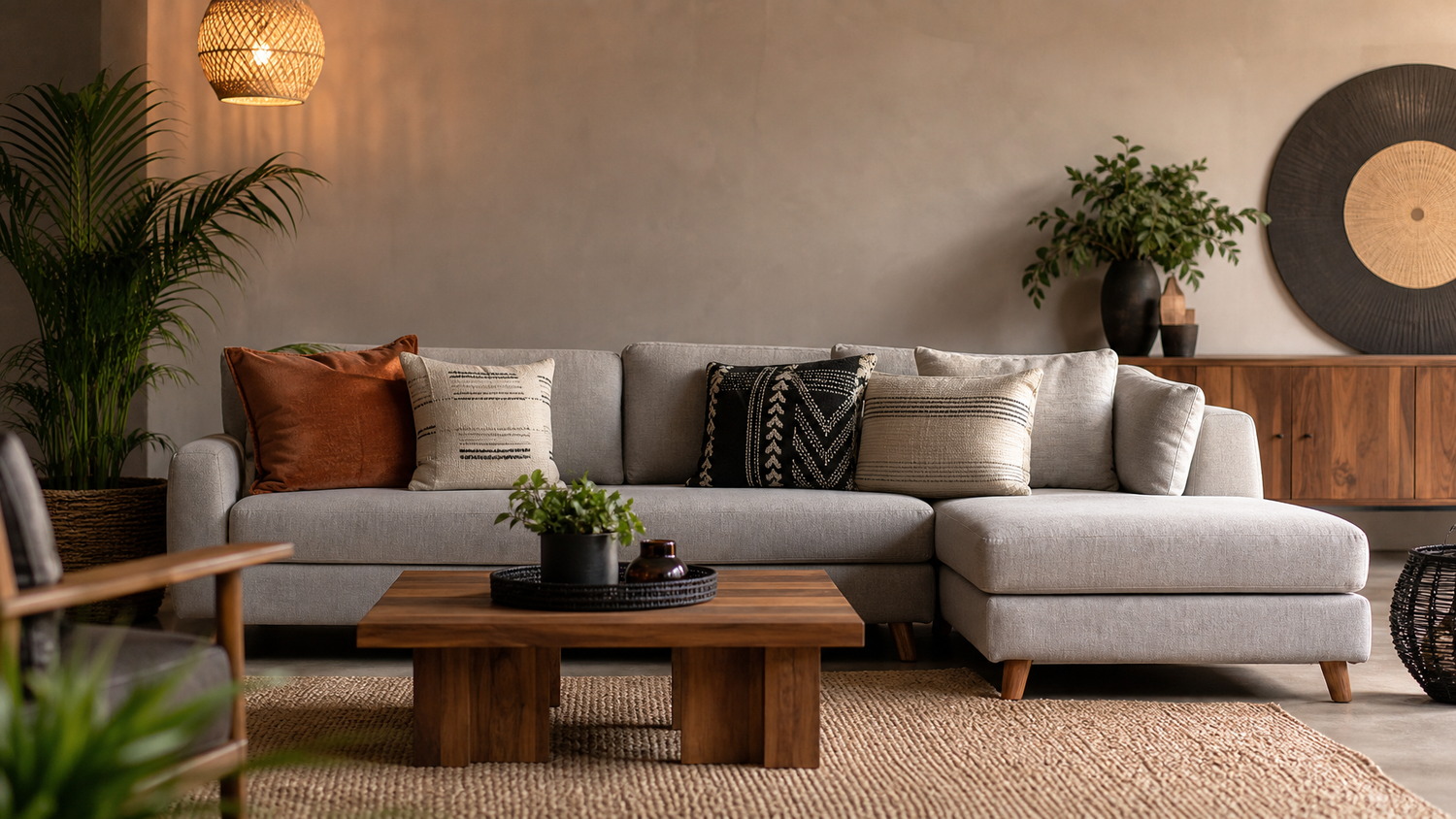
- Corner couch / L-shape: A single connected unit that forms an L or U shape. It sits flush against one or two walls, uses corner space efficiently, and typically offers seating for 5–7+ people.
- Sectional sofa: A modular configuration - individual pieces that clip or connect together. More flexible; you can reconfigure the layout.
- Standard sofa (2 or 3-seater): A single straight unit, easiest to move and reposition, works in almost any room.
Is a Corner Couch Good for Small Rooms?
Yes - with one important condition. The corner couch must fit your specific corner. The typical mistake is buying an L-shape that is too large for the room, which then blocks the TV or blocks doorways.
A properly sized corner couch for a small South African open-plan home can actually create more usable floor space than two separate sofas, because it consolidates seating into the corner zone and leaves the centre of the room clear.
Click Furniture's Bianca Corner Couch - available in Grey and Taupe - is a popular option for this exact reason. At R16,000 with free delivery, it is a premium mid-range choice that fits well in modern South African homes with open-plan living areas.
When to Choose a Standard Sofa Instead
- The room is narrower than 3.5 metres.
- You rent and move frequently.
- You want to rearrange furniture seasonally.
- You prefer a cleaner, less enclosed look.
Leather or Fabric Couch: Which Is Better in South Africa?
This is genuinely one of the most searched questions in South African furniture. The honest answer: it depends on your household. Here is a direct breakdown:
Leather Couches
Pros:
- Wipes clean instantly - a huge advantage with children, pets, and braai nights.
- Ages well with proper care; a quality leather couch lasts 15–25 years.
- Does not trap pet hair or allergens.
- Looks sharp in contemporary South African interiors.
Cons:
- Genuine leather is expensive - quality pieces start from R15,000+.
- Hot and sticky in summer if you do not have aircon.
- Scratches from pets show clearly.
- Requires conditioning every 6–12 months.
- Cracks in very dry, hot environments without regular treatment.
Fabric Couches
Pros:
- More comfortable in South Africa's warm climate - breathes better against skin.
- Wider colour and texture variety.
- Significantly cheaper for equivalent size.
- Softer and more forgiving for everyday use.
Cons:
- Stains are harder to remove than on leather (unless it is a performance fabric).
- Attracts pet hair.
- Some fabrics fade in direct sunlight over time.
The Verdict for South Africa
For families with young children or pets, a performance fabric couch (microfibre or treated linen) is the more practical and cost-effective choice. For adults-only households or minimalist interiors, a bonded leather or genuine leather couch is a worthwhile long-term investment.
Where Is the Best Place to Buy a Couch in South Africa?
South Africans have more options than ever - in-store, online, and everything in between.
In-Store Retailers
The major chains (Bradlows, House & Home, OK Furniture, Rochester) offer the benefit of trying before you buy. The trade-off is that prices are often higher, and in-store ranges are limited compared to online. Credit accounts and lay-by are the primary purchase mechanisms, which adds interest costs over time.
Online Furniture Stores
Online buying has matured significantly in South Africa. The advantages are real:
- Wider range: Online stores carry far more variants, colours, and sizes than any physical floor.
- Price transparency: You compare products side by side without a salesperson.
- Free delivery: Many reputable online retailers include free nationwide delivery on furniture orders.
- Returns policies: A good online retailer offers at least 7 days to return or exchange.
The key question to ask before buying online: does the retailer have a clear returns policy, reliable delivery tracking, and contactable customer service?
Click Furniture ticks all three. As a South African-based online furniture store, Click Furniture offers free nationwide delivery, a 7-day return window, and buy-now-pay-later (BNPL) options - which means you can split the cost across two months without the full credit account interest typical of in-store chains. Their sofa range starts from R5,000 and covers compact 2-seaters through to full corner suites.
What to Check Before Buying Online
- Clear product dimensions (width, depth, height, seat height).
- Multiple photos - front, side, detail shots of the fabric.
- Verified customer reviews.
- Explicit delivery timeline and coverage area.
- Warranty on frame and foam (at least 1 year; 3 years is better).
How Do I Clean and Maintain My Couch?
A couch that receives basic regular care will last twice as long as one that gets no attention until it is visibly filthy. The good news: couch maintenance is simple and takes less time than most people expect.
Fabric Couch Care
Weekly:
- Vacuum all surfaces - including between and under cushions - using an upholstery brush attachment. This removes dust, crumbs, and pet hair before they work into the weave.
- Rotate and flip cushions (if reversible) to distribute wear evenly.
Immediately (spills):
- Blot (never rub) liquid spills with a clean white cloth.
- Work from the outside of the stain inward to prevent spreading.
- For food stains: a mild dish soap solution (a few drops in cold water) works on most fabrics. Always test on a hidden patch first.
Monthly:
- Check the cleaning code on your couch label:
- W = water-based cleaners safe.
- S = dry solvent only.
- WS = either method is fine.
- X = vacuum only, no water or solvent.
Annually:
- Consider a professional steam clean for deep-set odours and allergens.
Leather Couch Care
- Daily: Wipe down with a soft dry cloth to remove dust.
- Spills: Wipe immediately with a clean, slightly damp cloth. Dry thoroughly.
- Every 6–12 months: Apply a leather conditioner to prevent cracking and keep the material supple. This is non-negotiable in Johannesburg's dry winters.
- Always: Keep leather away from direct sunlight and heat sources (including heaters and fireplaces). Prolonged UV exposure causes fading and cracking.
Quick Tip: Sun Damage
South Africa's sunlight is strong. If your couch sits near a large south-facing window (or north-facing in Cape Town), rotate it seasonally and use curtains or UV-filtering blinds during peak afternoon hours. Fading from direct sun is not covered by most furniture warranties and happens faster than most buyers expect.
The Bottom Line: What to Buy
The right couch for a South African home is one that:
- Fits your actual room dimensions (measure first, shop second).
- Uses a fabric suited to your climate zone and household.
- Sits within a budget that accounts for quality, not just sticker price.
- Comes from a retailer with clear delivery terms, a warranty, and a real returns policy.
If you are still unsure where to start, browse the full couch range at Click Furniture. Every sofa ships free nationwide, payment can be split over two months, and the 7-day return policy means you buy with confidence. From compact 2-seaters to large corner suites, the range is built specifically for modern South African homes.
Have a specific question not covered here? Browse the Click Furniture blog for more South African home guides.