Corner Couches in South Africa
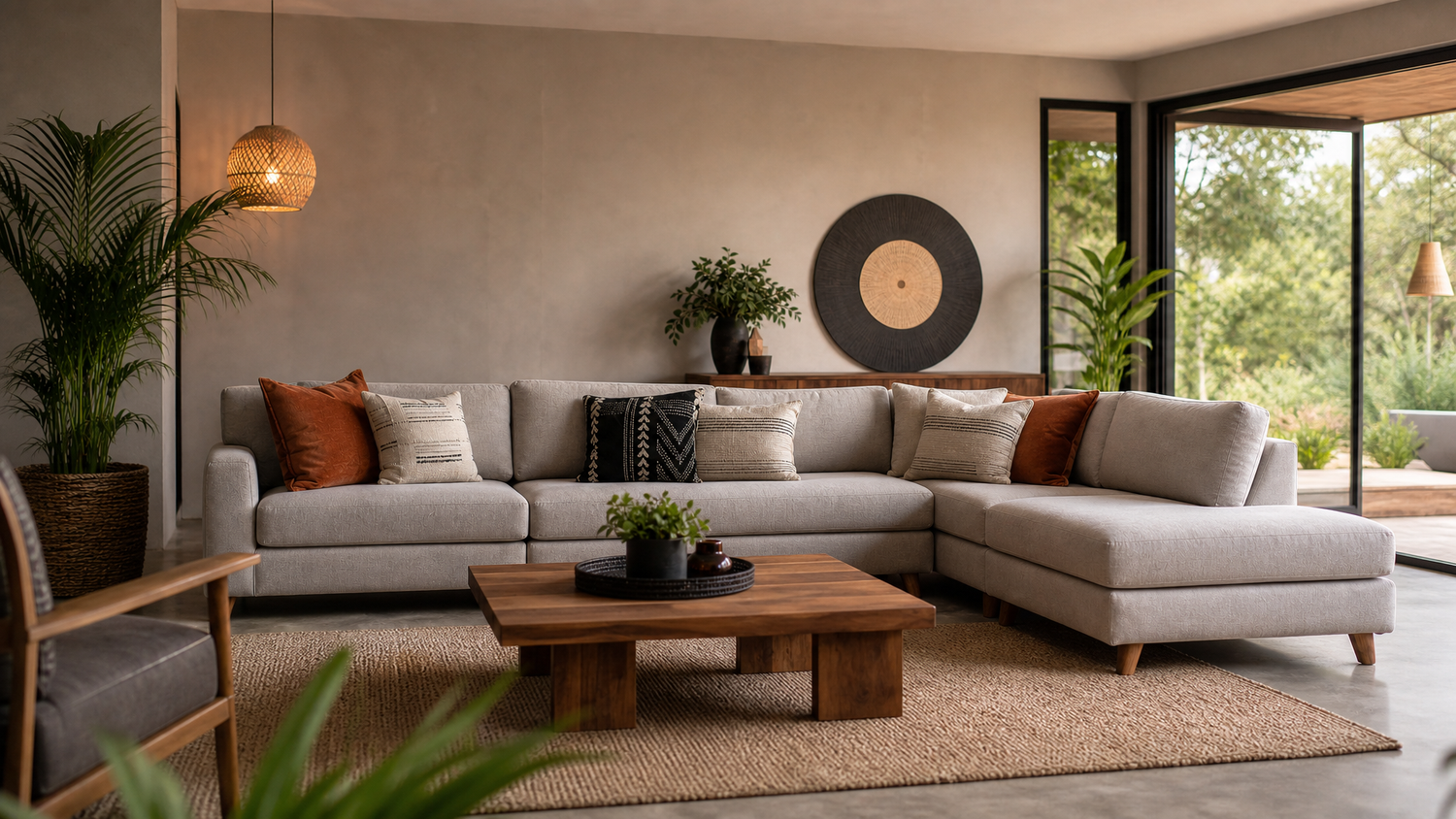
A corner couch is the centrepiece of almost every South African living room. It fills a corner, seats the whole family, and holds up through years of movie nights, Sunday braais, and school holiday chaos. But buying one online is intimidating when you are not sure about the size, the configuration, or whether you are getting the right fabric for your home.
This guide gives you everything you need to buy confidently. You will know your left-hand from your right-hand, your centimetres from your confusion, and your best colour options for a South African home before you finish reading.
TLDR
- A corner couch fills corner space efficiently and works in most South African living room sizes from about 3.5 m x 3.5 m upward
- Left-hand and right-hand refers to where the chaise or long section sits when you face the couch
- Fabric corners suit family homes with kids and pets; leather corners suit adults-only spaces and are easier to wipe clean
- Click Furniture stocks a wide range of corner couches with free nationwide delivery starting from around R4,999
Why a Corner Couch Works for Most South African Living Rooms
South African homes, whether it is a cluster in Centurion, a townhouse in Bellville, or a full stand in Polokwane, tend to follow a similar open-plan pattern. The living area and kitchen share space, and the lounge needs to seat multiple people without blocking traffic flow.
A corner couch solves this almost automatically. It tucks into the corner, keeps the centre of the room open, and seats six to eight people comfortably. Compare that to a three-seater and two-seater combo, which takes up more floor space once you account for the gap between the two pieces and often seats fewer people.
Corner couches also create a natural focal point around a TV wall or entertainment unit, which is exactly how most South African lounges are arranged.
Left-Hand vs Right-Hand Corner Couches
This is the single question that confuses more online furniture shoppers than anything else.
Here is the simple rule. Stand facing the couch as if you are about to sit down on it. If the long section or chaise is on your left side, you have a left-hand corner couch. If it is on your right side, you have a right-hand corner couch.
To figure out which you need, stand in the corner of your room where the couch will go. Look outward from that corner toward your TV or the main focus point of the room. The wall that runs to your left is where the longer arm of the couch will sit on a left-hand unit. The wall running to your right is where it sits on a right-hand unit.
A quick sketch on paper, even a rough one, saves a lot of confusion. Mark your TV wall, your entry point into the room, and your windows, then decide which configuration keeps traffic flowing naturally. Most South African living rooms work better with the longer section against the wall opposite the kitchen or away from the main doorway.
Corner Couch Sizes Explained
Corner couches measure width x depth, but the more useful measurement is the two external lengths that form the L-shape.
A typical entry-level corner couch in South Africa measures roughly 220 cm on the long side and 150 cm on the short side. A large family-sized corner couch can run up to 280 cm on the long side and 200 cm on the short side.
For standard South African open-plan living rooms, a couch with a long side between 230 cm and 260 cm fits most spaces comfortably. If your room is smaller, look for compact L-shaped designs that keep the short side below 160 cm.
Seat depth is also worth checking. A shallow seat of around 60 cm suits upright sitting and works well in smaller rooms. A deep seat of 90 cm or more feels more like a lounger, which is great for relaxing but takes up noticeably more floor space.
Always check the product dimensions on the listing and then measure your floor before ordering.
Fabric vs Leather Corner Couches
This is one of the most common questions South African furniture shoppers ask, and the honest answer is that it depends entirely on your household.
Fabric corner couches feel softer and warmer, which matters during winter in Johannesburg and the Cape Winelands. They come in a far wider range of colours and textures, from smooth velvet to chunky woven finishes. Good quality fabric holds up well to everyday use, though it absorbs spills more readily than leather. If you have young children or pets, look for covers that are removable and machine washable, or choose a performance fabric that repels liquids.
Leather corner couches clean up with a single wipe, which makes them the practical choice for homes with kids, pets, or people who eat on the couch regularly. Full-grain leather softens and improves with age. Budget-friendly leather-look fabric, also sold as PU leather or faux leather, gives you the same easy-clean surface at a lower price point, though it does not last as long as genuine leather. Leather can feel cooler in winter and warmer in summer, which can work either way depending on where you live.
The split in South Africa tends to fall along climate lines. Coastal homes in Cape Town and Durban often lean toward fabric for its warmth and texture. Inland homes in drier climates find leather easier to maintain.
How to Measure Your Space Before Buying
Get this right before you order anything, and you avoid the biggest headache in online furniture shopping.
You need four measurements.
1. Room dimensions. Measure the full length and width of your living room.
2. The corner. Measure from the corner itself outward along each wall to the nearest obstruction, whether that is a window, a door frame, or an archway.
3. Access. Measure your front door or entry corridor. A couch that cannot fit through the door is a serious problem. Most corner couches come in sections to help with this, but check with the retailer before ordering.
4. Clearance. Leave at least 80 cm to 90 cm of clear walkway in front of the couch for comfortable movement. Measure from where the couch will sit to the opposite wall or furniture piece.
Write these measurements down and compare them directly against the product dimensions on the listing. If you are unsure, the Click Furniture team is available to help you work through the numbers before you commit.
How Much Does a Corner Couch Cost in South Africa
Corner couches represent a big purchase and prices reflect the range of quality available.
Entry level (R4,000 to R7,000) covers fabric L-shapes in standard neutral colours, typically on wooden or metal frames with foam seat cushions. These suit rentals, first homes, and budget redecoration projects. They look the part and function well, though they may show wear sooner than mid-range options.
Mid-range (R7,000 to R12,000) brings you better frame construction, higher-density foam, and a wider selection of fabric options. This is where most South African shoppers find the best balance of quality and price. You can expect a couch at this level to last five to ten years with reasonable care.
Premium (R12,000 to R16,000+) gives you solid hardwood frames, top-grain leather or premium fabric, and designs that hold their shape and look excellent for well over a decade. These are the couches worth investing in if you own your home and intend to stay.
Click Furniture stocks corner couches across all three tiers with free nationwide delivery on every order.
Corner Couch Colours That Work in South African Homes
Neutral tones dominate the South African lounge for a reason. They go with almost everything, they do not date quickly, and they give you flexibility when you redecorate around them.
Grey remains the most popular corner couch colour in South Africa. It pairs with warm wood tones, white walls, and both cool and warm accent colours. Light grey works in smaller rooms by reflecting more light. Charcoal grey suits larger, darker rooms with bold accent walls.
Beige, cream, and greige (the grey-beige hybrid) suit homes with warm undertones, timber flooring, or lots of natural light. They read as timeless and work well with terracotta, olive, and rust accents that are trending strongly in South African interior design.
Caramel and tan leather is a perennial favourite and continues to sell well, particularly for genuine and faux leather options. It brings warmth without being heavy and suits both modern and more traditional South African interiors.
Bold colours like forest green, navy, and burnt orange work well as statement couches in white or light-walled rooms. If you go bold, pair the couch with a natural-fibre rug and simple coffee table in a neutral tone to keep the room balanced.
Avoid very pale white or off-white couches unless your household has no children, no pets, and no regular entertaining. They stain easily and are difficult to maintain in a family home.
Shop Corner Couches at Click Furniture
Click Furniture stocks a wide selection of corner couches to suit every South African living room. Whether you want a compact L-shape for a smaller flat or a large family sectional with extra seating, you will find it at clickfurniture.co.za/collections/lounge.
Every order comes with free nationwide delivery, a 7-day return window, and buy-now-pay-later options so you can spread the cost over two months. While you are planning your lounge, browse the coffee table range to complete the look.
Frequently Asked Questions
What is the difference between a corner couch and a sectional couch?
They refer to the same product. A corner couch or corner sofa forms an L-shape that fits into the corner of a room. The term "sectional" comes from the fact that most of these couches arrive in two or three modular sections. In South Africa, "corner couch" and "L-shape couch" are the most common terms.
How do I know if a corner couch will fit in my room?
Measure the two walls where the couch will sit and compare those lengths to the couch dimensions on the product listing. Also measure your doorway and entry corridor to make sure the sections can be moved in. Leave at least 80 cm of walking space in front of the couch.
How long does a corner couch last?
A good quality corner couch in the mid-range price bracket lasts between five and ten years with regular use. A premium hardwood-frame option with quality upholstery can last fifteen years or more. Entry-level couches typically last three to five years before the foam and frame show significant wear.
Is it better to buy a fabric or leather corner couch?
Fabric suits households that prioritise comfort, warmth, and colour variety. Leather suits households that prioritise easy cleaning and a sleek look. Both work well in South African homes. Your lifestyle, climate, and household makeup should drive the decision more than aesthetics alone.
What size corner couch fits a standard South African living room?
A corner couch with a long side of 230 cm to 250 cm and a short side of 150 cm to 170 cm fits comfortably in most South African living rooms of 3.5 m x 4 m or larger. Smaller rooms suit compact L-shapes. Larger open-plan rooms can take a full sectional with a long side of 270 cm or more.
Can I return a corner couch if it does not fit?
Click Furniture offers a 7-day return window. Always measure carefully before ordering, and contact the team if you need help confirming dimensions before your purchase.